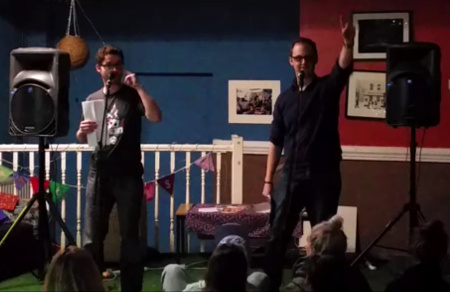
MULE is always looking for new writers, and we work with people of all abilities. The kind of stuff we’re after is sharp news and reporting on social, political and cultural goings on in Manchester, but we also take a look at things happening further afield from time to time. We’re a volunteer run organisation, who would love to be able to pay people for their writing, but just can’t afford it at the moment!
Interested? Contact Michael Pooler on editor@themule.info – he’s friendly and will reply.
Your Ideas
Do you have a story you would like us to cover? Is there something going unreported in your local area that you think needs to be out there?
MULE believes passionately in the need for independent local media. We want our paper to be relevant to local people and communities, and that’s why we would love you to get in touch with us.
If you have any ideas or suggestions, send an email to editor@themule.info and we’ll take a look for the next issue or sooner on the website.
A SHORT GUIDE TO WRITING FOR THE MULE
Articles for MULE should:
1. Be well-written in clear, concise prose and coherently structured.
2. Not exceed the agreed article length and be submitted on the agreed date.
3. Offer a unique perspective or slant that is ignored or under-represented in the dominant media.
4. Be your own work and not directly reproduced from press releases or from other sources without clearly stating so.
5. Be original and not a re-hash of a well-worn subject.
6. Avoid specialist jargon where possible but if required to use it then explain fully.
7. Adopt a neutral tone and report incidents rather than comment (news articles).
8. Present clear arguments and not resort to ranting (comment and analysis).
9. Avoid racist, sexist, homophobic or other discriminatory language.
10. Avoid endorsing specific political parties
MULE retains the right to edit articles to fit these criteria
TIPS FOR GOOD WRITING
MULE aims to be easy to read and factually accurate. These style notes provide a guide to achieving this objective. Keep things simple; make them direct. MULE’s house style is intended to make the paper readable and easy to understand, concise and unambiguous. Here are some general pointers
- Let facts speak for themselves – lay off the polemic.
- Put people in your story! Track down those involved in the issue you’re writing about, and get their comments.
- For leads (opening lines) stick the boring bit at the end of the sentence after a comma (ie. Landowners regularly tortured small children, chewed rabbits’ heads off and spat at servants, according to a new report by the Landed Gentry Historical Society.)
- Cut out superfluous adjectives and phrases, and shorten, break up and/or re-word awkward or lengthy sentences.
- Unclutter your sentences by using as few commas, hyphens, italics and accents as necessary.
- Write in the active tense (‘Police arrested ten people’, not ‘Ten people have been arrested’) to keep sentences fresh and unclogged.
- Omit all pretentious or flowery language.
- Avoid redundant phrases such as ‘actually’, ‘really’ and ‘certainly’.
ACCURACY
MULE is a small paper – we don’t have teams of fact checkers and lawyers – so always look out for contentious allegations that might risk libel actions. If in doubt, check with the editor or production editor. If you’re new to researching companies or public bodies, check out this guide available to download in pdf. form from Corporate Watch.
GENERAL STYLE GUIDE
Make sure you check all the spellings of names and places, all book titles and names of films, plays and songs, as well as dates. Furthermore, be cautious over the credibility of the source you use to check them from.
Whenever you provide the name of a person, institution, piece of legislation and so on, check the spelling (preferably on the BBC or relevant institutional website).
Provide the information that tells readers who or what someone/something is – ‘government minister Godfrey Gradgrind’ (NB to editors/sub-editors: All names, of people, places and organisations, need checking as a matter of course)
Sources/citations/references
Detailed references are not always included in the published text but MULE still needs to know the source of important quotes, statistics and other facts for checking purposes. In the rare case of references within articles or footnotes, the style is: Title of publication by Author’s Full Name (Publisher, date).
Quotes
Use single quote marks, with double quote marks for quotes within quotes. Make sure they are smart (‘curly’) quotes, not straight quotes.
Include full stops or other punctuation within quotes for full sentences; punctuation goes outside quotes for individual words or phrases short of a full sentence. Examples: Cherie Blair said, ‘That’s a lie!’ Cherie Blair said Gordon Brown’s comment was ‘a lie’.
Introduce quotes with a comma. Example: she said, ‘If it’s not too late.’
Choose a tense for quotations and then stick with it, unless you are clear that you are changing the chronology of your story. Use ‘she says’ or ‘she said’ but don’t chop and change.
And always introduce someone before you quote them.
Numbers
Spell out numbers one to ten, except for percentages, which always go in figures (with per cent spelled out: 9.9 per cent, 2 per cent etc), or decimal figures (e.g. 2.5 million) or currency etc (e.g. £2).
Spell out (or better, avoid) numbers at the beginning of sentences F) or prefix with “Some” “under” “over” or “up to” or “a total of”
Large numbers: two million, not 2,000,000, nor 2 million, nor 2m; seven billion, not 7 billion, nor 7bn).
Percentages are singular – ‘30 per cent of the public believes’.
For ages, twenties, 20, 20-year-old but twentysomething.
NB: ninth and tenth, but 11th.
Always insert the relevant commas in thousands e.g. 1,000, 2,544, 10,000 etc.
Exceptions: Radio 4, Channel 4
Dates and times
Style is 5 November 1999. Use 1960s rather than sixties or 60s; 20th century rather than twentieth (no superscript). NB 20th-century (hyphenated) when used as adjective. Use 1994-95 rather than 1994-5. Use 9/11 and 7/7 if you must, but no others. Avoid ‘this month’ or ‘last month’ – spell out the month and if necessary year.
Titles
Italicise all titles of books, newspapers, magazines (including MULE), films, videos, albums, plays, paintings, exhibitions etc. But essays, articles, short poems and songs are in single quote marks. Use capitals for the titles, with definite and indefinite articles, conjunctions and all prepositions up to four letters long in lower case, eg Gone with the Wind. For titles with a sub-title separated by a colon, use capitals for the first part and lower case thereafter (Stop the War: the story of Britain’s biggest mass movement).
Capitalisation
First letter of first word only is capitalised in headings and subheadings. Capitals are reserved for proper nouns. Only use them when giving a proper noun in full. Not the ‘Asylum Act’ but the ‘Proper Name of the Act’. The proper noun is the whole name, the ‘Asylum Act’ is maybe short-hand for that name and, therefore, not a proper noun.
Avoid unnecessary capitalisation.
Use lower case after colon (including in long book or article subtitles), except when introducing direct quotes. (The editor stated: ‘This is worth reading.’)
We prefer north and south, east and west, when talking about geo-political regions, and north London, northern England, eastern Europe for general locations. Also third world, but the global North and the global South is acceptable in the development sense.
Religions: capitalise Catholic, Protestant, Muslim, Hindu, Sunni, Shia. Prefer unionist, nationalist, republican etc in politics.
Use cd and dvd, but TV rather than tv. Use plc not PLC. NB No apostrophe in plurals e.g. cds dvds, not cd’s, dvd’s.
House of Commons and House of Lords but parliament is lower case, as is the government. Use white paper, bill and act of parliament unless using the full title as a proper noun.
Titles such as prime minister, secretary of state, president etc are lower case unless using (for example) President Bush, Prime Minister Brown etc. Likewise with job titles such as director, professor, head teacher, army rank and so on.
Acronyms
Never leave an unexplained acronym. Spell out names of organisations in full on first use, with initials or acronyms afterwards. Exceptions are everyday acronyms: BBC, NHS.
For those popular and well-known acronyms which are normally pronounced as a word (Aids, Nato, Patriot Act) use initial cap and lower case for rest (but DSEI, NO2ID).
With some organisations, such as unions, the form ‘white-collar union MSF’ is clearer than ‘Manufacturing, Science and Finance’.
Names
As with organisations, spell out full names of people on first use. Thereafter prefer surnames unless informal or personal style requires forename.
Abbreviations
Spell out with abbreviations in brackets first (except the obvious – UN, EU, US).
Avoid etc, ie and viz.
Do not use points in either upper case initials (eg US) or lower case (am, pm, eg, etc).
Software settings
If you are using Microsoft Word, make sure you have selected English (UK) as the language under both Tools/Language/Set Language and Tools/Options/Spelling & Grammar/Dictionaries.
Use smart quotes (the curly, not straight, ones) and turn off hyperlinks under Format/Autoformat/Options
Don’t use footnotes (incorporate references in text or at end of article).
Range text left (don’t centre or justify); single line spacing; one line between paragraphs; one space between words; no extra spaces after the end of sentences; plain black text; don’t do anything fancy!
Spelling
Avoid American English spellings, except for US proper nouns. Don’t rely on Word or other spelling or grammar checks (but make sure your word processing software is set to UK English). Use a good dictionary: http://www.onelook.com/ will search around 1,000 online dictionaries simultaneously.
See Spelling Guide (below) for further information.
Sexism, racism and discrimination
Avoid being prissy or ‘politically correct’, but it is always a good idea to take into account people’s sensibilities about gender, race, sexual preferences, disabilities and so on. Use ‘black’ (no capitalised ‘b’) or ‘Asian’ as appropriate. ‘Business executive’ is preferred to ‘businessman’, ‘supervisor’ to ‘foreman’, ‘police officer’ to ‘policeman’ and so on.
It is worth checking up with disability rights groups’ guides (available on the internet) that contains up to date advice on how people with disabilities like to be referred to.
Miscellaneous
Don’t use ‘like’ (meaning similar) when you mean ‘such as’ (giving an example)
Revisions or common errors to note:
Single quotes, not double
Spell out ‘per cent’
Spell out numbers under ten
Extra help
Refer to the Guardian style guide (available online at http://www.guardian.co.uk/styleguide) for help on usage, spelling and other issues not covered here.
Additional notes for editors and any writers who are still reading
Apostrophes
No apostrophe when referring to organisations by initials in plural form – LEAs, PPPs etc. 1980s not 1980’s.
Lower case/caps
Avoid caps wherever possible – in general, follow Guardian style. In particular: anti-semitism, black, cabinet, green, government, internet, cold war, currencies (pound, euro, dollar etc) parliament, seasons (eg, winter)
and third world. Exceptions: Generally, use caps where there is any significant risk of confusion – for example, the (global) South
Miscellaneous
An elipsis is typed thus … (i.e. three dots with a single space on each side)
Transliterated names
MULE prefers: Beijing rather than Peking; Mumbai rather than Bombay; Muammar Gaddafi; Yasser Arafat.
Genetives
Use apostrophes according to common usage or the way a word is spoken. Generally, prefer Charles’s rather than Charles’ but note that there are different common uses, especially in place names – for example, St James’s Park (London) and St James’ Park (Newcastle). And don’t even ask about Earls Court . . .
Non-English words
Italicise words from foreign languages, except where they are in common English useage or proper nouns
Accents
Do not put accents on common words such as cafe, elite, detente or bric-a-brac. Include only in foreign words and people’s names. Exceptions: cliché, exposé.
Spelling
Use –ise, not –ize (eg, organise and recognise). When more than one UK English spelling is current (eg yoghurt and yogurt), go for the most common.
Names
In general, use familiar English spelling for proper names and names of places (Milan rather than Milano), but see Transliterated names below. Geographical style: Use Times atlas spellings. Initials before surnames: no spaces, eg AJP Taylor. Do not use a full point after Mr or Dr. NB: It can be patronising to use first names only, yet many journalists refer to, for example, black people in this way. Please give full name on first use (including celebrities), then use surname (there are exceptions, eg, A Day in the Life).
Miscellaneous
al- (nb l/c and hyphen)
anti- (hyphenated – for example, anti-semitism)
co-operatives (co-ops), but cooperation
counter- (hyphenated, but counterculture)
decision maker, policy maker
email
enquiries
first, second, third rather than firstly
grassroots (n) but grass-roots if adjective preceding noun
judgement
legal aid – lower case
media – singular in Red Pepper
multi- (but multinationals)
neoliberal (no hyphen)
nonviolent (no hyphen)
politics – As a profession or subject for study, singular – eg, ‘politics is a dirty business’; party politics, plural.
postmodern
t-shirt (lower case t)
television
think-tank
trade union
workforce
worldwide
Names
al-Qaeda
Ayad Allawi
Ba’ath
Osama bin Laden
Cancún – accent over the ‘u’
Channel 4
Chechnya
Falluja
Gaddafi
Gandhi
Gorbachev
Guantánamo Bay – accent over second ‘a’
Hassan Jumaa Awad
Izzedine al-Qassam – the military wing of Hamas
Karbala
Rosa Luxemburg
Mao Tse-tung
McDonald’s
Mehdi – Shia militia
the Midlands
Moqtada Sadr
Mother Teresa
Nasiriyah
Porto Alegre
Radio 4, Channel 4
Sadr City
Shia
Taliban
Tiananmen
US – rather than USA or America
Miscellaneous Spelling
anti- (hyphenated – for example, anti-semitism)
co-operatives (co-ops), but cooperation
counter- (hyphenated, but counterculture)
decision maker, policy maker
email
enquiries
first, second, third rather than firstly
grassroots (n) but grass-roots if adjective preceding noun
judgement
legal aid – lower case
multi- (but multinationals)
neoliberal (no hyphen)
nonviolent (no hyphen)
politics – As a profession or subject for study, singular – eg, ‘politics is a dirty business’; party politics, plural.
postmodern
t-shirt (lower case t)
think-tank
trade union
workforce
worldwide
amid and while (as opposed to amidst and whilst)