

Bye Bye Birley Fields
Article published: Wednesday, October 21st 2009
Manchester Metropolitan University (MMU) is planning a new development on green space in Hulme. They label the construction the “greenest campus in the UK” and say plans will balance the needs of the local community, but Hulme residents have their doubts.
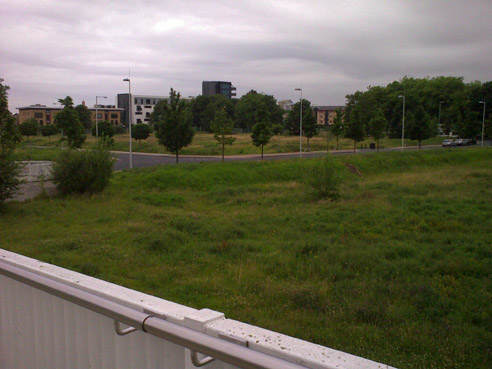 MMU state that “environmental sustainability is integral to all design” and maintain that the £120-million development on Hulme’s Birley Fields will incorporate technologies to minimise carbon use, save energy and cut waste. Buildings will use ground-source heating and solar energy while maximising natural lighting. And a Green Travel Plan will focus on reducing car use, increasing use of public transport and prioritising pedestrian and cycle usage.
However, the plans have met a raft of criticism from local residents and environmental campaigners alike.
The promise of jobs for local people has been soured by the fact that the new campus will consolidate existing campuses in Didsbury and Oxford Road, from where most jobs will be transferred.
There are also concerns regarding car parking. The provision of an additional 400 spaces seems at odds with green transport plans and the diversion of traffic from Bonsall Street will likely mean more traffic on the already congested Stretford Road.
Amid criticism over the plans has come the revelation that the Council gave the land to MMU for free, justified “on the basis of the economic and regeneration benefits of the development”. MMU estimate that the campus will inject £29 million into the local economy annually, but this has failed to allay concerns that Hulme will turn into another Fallowfield, where the high student population has led to exclusion for local residents. News that half of the buildings are to be residential halls have only fuelled this fear.
“The first meeting 18 months ago was an invite-only for local businesses. A lot has clearly been going on behind the scenes with the Council for some time. Congestion will be a nightmare in an area where air quality is already poor,” said local resident Dave Sage.
In 2006 a Permaculture design course was held in Hulme which proposed a practical, community-based garden on the green space. Yet the two concrete designs put forward have been largely ignored. On offer instead is Hulme Square, an “extensive green area linked to surrounding areas of trees and grassland”.
In response MMU said that many meetings have been organised to inform local residents of the plans and told MULE that 72 per cent of residents responded positively to the development during the consultation process. They are now planning are to hold an environmental sustainability workshop involving members of the local community with a specific interest in ‘green’ issues as part of the consultation programme. They say that this will inform the development plan going forward. Building is due to start next year.
Comment: A case for not building
By Rob Squires, Hulme resident
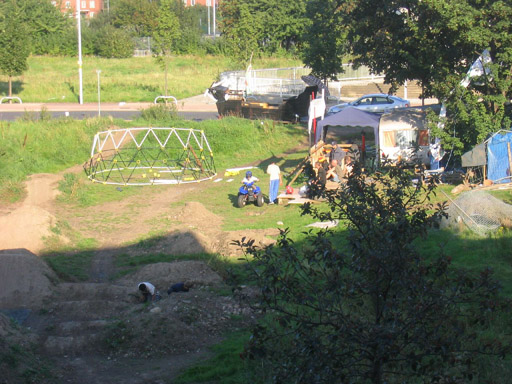 It is ironic that while MMU is planning to build a new medical campus on Birley Fields they are undermining the health and wellbeing of the local community. As a local resident I don’t want to see the facility built, and believe the land can benefit the local community and the economy more as a green, open space. In Manchester we face serious health inequalities, and there is increasing scientific evidence, and government policy in the pipeline supporting the retention of natural spaces on the basis of health and wellbeing.
Almost one in four adults is obese, and by 2050 this figure could rise to nine in ten. Along with poor diet, lack of physical activity is the major cause of obesity, and only 40 per cent of men and 28 per cent of women attain the government’s target for physical activity. The cost of inactivity in England is estimated at around £8.2 billion a year. Mental health is another huge issue, and is particularly acute in inner city areas like Hulme.
Government mental health official Jude Stansfield advises that “the protection and reclamation of public space”, and “schemes to open up land for community cultivation”, are examples of good practice in public health. Put simply, by increasing access to open space, and opportunities for physical activity there could be improvements in public health and savings for the NHS. Research by Dr Sjerp de Fries has shown that increasing green space reduced health complaints. In addition Frances Kuo has evidenced that green space in inner city areas reduces residents’ mental fatigue and the psychological impacts of stressful life events. Consequently the Zion Health Centre in Hulme has a therapeutic garden which provides a resource for people with mental health issues.
Since 2005 public health has been empowering communities to have a say in how health and well-being services are delivered in their area. Around then Friends of Birley Fields conducted a residents’ survey which indicated many in Hulme would prefer green and social initiatives on the site. Despite the fact that MMU are building a ‘green’ campus, I do not believe it will be socially or economically sustainable, and it is not being built for the benefit of the people that live in the area.
You can join the Facebook group Our Hulme here
More: Council, Education, Environment, Features, Local economy, Opinion
Comments
-
Pity they used such a rubbish photo to illustrate the article. We have several very nice photos on the “Our Hulme” Facebook page. Please join and also fill in the online survey – link on the facebook page.
Comment by Nigel Woodcock on October 22, 2009 at 6:53 pm -
Regardless of the pros and cons of the development, giving the land for free is outrageous. I’d be interested to see how much this happens in other situations – I’m sure some of the other developers in this city have got land for a pittance.
Comment by lou on October 22, 2009 at 7:02 pm -
@Nigel
That’s my “rubbish” photo! Probably something to do with the fact that if you search Flickr for “birley fields” it’s one of a small few that is of birley fields, and has a creative commons licence for reuse. The author has rightly respected this.
http://www.flickr.com/search/?w=all&q=birley+fields&m=text
Comment by Steven Flower on October 22, 2009 at 10:27 pm -
MMU siad, “many meetings have been organised to inform local residents of the plans”. Emphasis on inform, as opposed to asking what resident want. Their meetings go along the lines of: What flavour campus do you want? Point is, nobody ever asked residents if they want a campus. So that’s what we are doing – you can fill in a short online survey, to say whether or not you would like a campus, or what else on Birley Fields: https://www.surveymonkey.com/s.aspx?sm=BY73WGlVv0KdeHyEqycOCg_3d_3d
Rob
Comment by Rob Squires on October 23, 2009 at 10:19 am -
It breaks my heart to see this green space of Hulme be given away to the MMU.I would have liked to have seen part of it given to the Hulme residents as a: garden,allottments,inner city farm,some housing that copied the style of the old back to backs that once stood there(updated with inside wc and bathroom of course.)
The issue/future of Birley Fields for me,has always been about sharing what ‘space’ there is available in Hulme with the local community and these development plans by(MMU)are NOT taking these needs into account-how can they?
What worries me also is the future of the land that the Hulme Hippodrome stands on.If the Hulme Hippodrome is pulled down what will happen to that particular ‘space’ then? Will any future development of the Hulme Hippodrome site also sound the death knoll for the very close area that houses the Hulme Community Garden Centre?
It would be so nice if planners,owners and developers of any potential future ‘green space’ of Hulme shared their initial’plans’ with the local community who will be forced to live with the consequences of them for a long time to come.Perhaps it’s all a question of developers not being able to see the trees for the wood?
Comment by Jo on October 26, 2009 at 3:18 pm -
Thumbs up to ‘community campus’
MMU ‘good for hulme’HULME and Moss Side residents have given a strong ‘thumbs up’ to proposals for a university campus in their community.
Four-fifths of people quizzed on the £120 million campus for Manchester Metropolitan University believe that the proposals will have a positive impact on their neighbourhood.
MMU‘s ‘community campus’ at Birley Fields, was approved in principle by Manchester City Council’s Executive in June as a key part of the regeneration of the district.
Sustainable campus
A single campus for 6,000 staff and students in Education, Health and Social Care, is central to the University’s mission to train ‘world class professionals’.
Among the university’s proposals is a commitment to make the campus the most sustainable in the UK with significant open space and an aspiration to produce zero waste, water and carbon dioxide.
Three-months of community consultation have seen 4,000 local people offer their views in person at more than 40 events, covering shopping areas, libraries, community centres, schools and places of worship in Hulme and Moss Side.
Tom McGee, spokesman for Loreto College, one of the venues, said: “We have been kept very well informed. Local people are very interested in the MMU’s proposals and the more they learn, the more they are warming to it.”
8,000 newsletters and freepost questionnaires were also delivered to homes and
Comment by richard walker on October 27, 2009 at 2:28 pm
businesses, with a further 5,000 handed out at community venues. 835 questionnaire responses were returned – a quarter via the web. -
I think that social exclusion is a much bigger issue than the environmental one.
Hulme residents will begin to be systematically excluded as the students get priority in the area. Just look at what has happened in Fallowfield and Withington.
People are looking for something to improve the quality of their lives i’m not sure that this development will do this.
Interestingly some people who filled out the survey also also wanted to have a sports center despite the fact there is already one 100 yards down the road. This seems strange.
There were also many leading questions in the survey. The fact is you can call the results into question.
Comment by TIm on October 27, 2009 at 10:49 pm -
Shame to see the bias in articles such as this – did the author actually talk to anyone from MMU? Doesn’t seem like it. Yes the development is questionable but isn’t helped by such partisan opinion pieces.
Comment by Kim on October 28, 2009 at 12:14 am -
The last paragraph:
“In response MMU said that many meetings have been organised to inform local residents of the plans and told MULE that 72 per cent of residents responded positively to the development during the consultation process. They are now planning are to hold an environmental sustainability workshop involving members of the local community with a specific interest in ‘green’ issues as part of the consultation programme. They say that this will inform the development plan going forward.”
That seems to me like the author spoke to MMU.
Comment by andyl on October 28, 2009 at 12:36 pm -
The first piece is NOT a ´partisan opinion´ piece. I and another writer wrote it and we spoke to Gareth Hollyman, press officer from MMU amongst others. If you have any queries over stated statistics or purported facts, email me personally and I can show you their sources.
Comment by M on November 6, 2009 at 12:40 pm -
Moreover all the information is freely available in the public forum.
Comment by M on November 6, 2009 at 12:41 pm -
[…] dominated by students. Manchester Met University (MMU), in conjunction with the City Council, is planning to build its new ‘super campus’ on Birley Fields, a green space just a stone’s throw from the bar. This proposal was also met […]
Pingback by Hulme regeneration update — MULE on February 22, 2010 at 9:32 am -
[…] anger from locals that there had been a lack of serious consultation over the plans came the revelation that the […]
Pingback by MMU’s rise in Green Table proves controversial in Hulme — MULE on June 25, 2010 at 6:18 pm -
Two of the funding agencies supplying money to the MMU for the development of the Birley field campus,are to be disbanned by the con/lib government.(NWDA & HEFA).
Comment by RICHARD JONES on July 13, 2010 at 4:42 pm -
What a waste. Just found out about this. This green space has many benifits for both wildlife and those passing by. Central Park would not be handed over to developers why is the self called green city so eager to hand out hulme?
Comment by Dave S on July 20, 2010 at 3:07 pm -
http://www.nwda.co.uk/news–events/press-releases/201001/birley-fields.aspx
Quoted
“Now the proposals have been backed with £10 million from the Higher Education Funding Council for England (Hefce), and a £8.5 million grant from the Northwest Regional Development Agency (NWDA)”The funding has now been pulled totally, I wonder how this leaves the project.
Comment by Hulme born and bred on July 29, 2010 at 9:15 am -
Ammended !
Should read that the NWDA portion £8.5 million has been pulled …..it might be read incorrectly.
Comment by Hulme born and bred on July 29, 2010 at 9:41 am
The comments are closed.